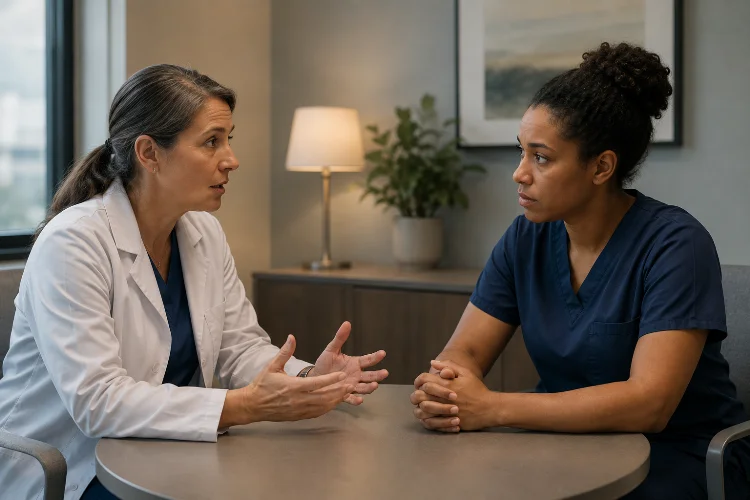
Few parts of clinical teaching feel as uncomfortable as telling a learner that something is not going well.
Maybe they repeatedly miss an important safety step, struggle with clinical reasoning, respond poorly to feedback, or behave in a way that affects patients or colleagues. Ignoring the issue may feel easier in the moment, but it rarely helps the learner.
Knowing how to prepare for a difficult learner conversation makes these discussions clearer, fairer, and more productive.
Effective feedback in health professions education should help learners understand the difference between their current performance and the expected standard, while giving them a realistic path toward improvement.
The goal of a difficult conversation is therefore not to “win” an argument or prove that the educator is right. It is to explain the concern accurately, understand the learner’s perspective, protect patients and professional standards, and agree on what needs to happen next.
Good preparation makes that much easier.
Be Clear About Why the Conversation Is Necessary
Before meeting the learner, identify exactly what needs to be discussed.
Avoid starting with a vague feeling such as, “Something about this student worries me.” Instead, ask yourself what behavior or performance gap you have actually observed.
Perhaps the learner repeatedly fails to recognize abnormal observations. Maybe they arrive late, do not prepare for assigned patients, communicate disrespectfully, or require more supervision than expected at their stage.
Clinical teachers may recognize struggling learners early, but effective support requires moving from an overall impression toward identifying specific areas of difficulty.
Write the main concern in one clear sentence.
For example:
“During three observed medication rounds, the learner required prompting to complete the required patient identification checks.”
That is much easier to discuss than:
“You don’t seem safe.”
Specificity gives the conversation a fair starting point.
Gather Evidence Before the Meeting
A difficult learner conversation should be based on evidence, not memory, personality, or frustration.
Review your observations, written feedback, competency requirements, previous discussions, and any relevant assessment records. If other supervisors have raised concerns, make sure you understand what they directly observed rather than relying on rumors.
Professional standards for student supervision and assessment emphasize objective, evidence-based judgments about learner achievement and progression.
Evidence can include dates, clinical situations, level of prompting required, feedback already provided, and whether the behavior improved afterward.
For example:
“On Monday and Wednesday, you needed prompting before escalating deteriorating observations. We discussed escalation after Monday’s shift, but the same issue occurred again on Wednesday.”
This gives the learner something concrete to respond to.
Good evidence keeps the discussion focused on performance rather than personal judgment.
Separate the Learner From the Problem
Language matters.
Statements such as “You’re careless,” “You’re difficult,” or “You’re not professional” can make a learner feel personally attacked. They also provide little information about what needs to change.
Focus on behavior instead.
Instead of:
“You’re careless with documentation.”
Try:
“Three patient notes were incomplete at handover, including one that did not contain the updated assessment findings.”
Feedback research recommends specific, behavior-focused information that gives learners a clearer understanding of the performance gap.
This does not mean avoiding direct language when an issue is serious.
You can say:
“I am concerned about patient safety because this identification step has now been missed more than once.”
That statement is clear and serious without turning the concern into an attack on the learner’s character.
Choose the Right Time and Setting
Do not start a significant performance conversation in a corridor, at the nurses’ station, or in front of patients and colleagues.
Find a private setting where both people can concentrate.
Allow enough time for the learner to respond. A conversation about repeated clinical concerns should not be squeezed into two rushed minutes before the end of a shift.
If the issue involves immediate patient safety, of course, intervention cannot wait. Stop unsafe practice first and address the immediate situation.
A more detailed conversation can happen once the patient is safe.
Clinical learning standards place both learner support and public protection at the center of supervision and assessment.
Preparing the setting communicates that the conversation matters and deserves professional attention.
Plan How You Will Open the Conversation
The first few sentences can shape everything that follows.
Avoid long introductions that make the learner increasingly anxious.
Be respectful but direct.
For example:
“I’d like to talk about your recent patient assessments. I’ve noticed a repeated issue with recognizing when findings need escalation, and I want us to look at what’s happening and agree on how we can improve it.”
The learner immediately understands the subject and purpose.
Another useful approach is to signal both concern and support:
“There are some areas of your performance that are currently below the expected level. I want to explain what I’ve observed, hear your perspective, and then work out what support and improvement steps are needed.”
Research on struggling learners highlights the importance of systematic assessment and individualized remediation rather than simply labeling a learner as weak or problematic.
Directness can actually be kinder than making the learner guess what the meeting is about.
Give the Learner Space to Explain
Once you describe the concern, stop talking.
Ask:
“How do you see the situation?”
Or:
“Is there anything affecting your performance that you think I should understand?”
The learner may reveal something important.
Perhaps they misunderstood the expected standard. Maybe they have received conflicting instructions from different supervisors. They might be struggling with workload organization rather than clinical knowledge.
Sometimes they may disagree completely.
Listening does not mean automatically accepting every explanation. It means gathering enough information to understand the problem before deciding what should happen next.
Feedback is increasingly understood as an interactive process in which learner engagement affects whether information ultimately leads to improvement.
A learner who feels heard may also be more willing to engage with the next steps.
Stay Focused if the Conversation Becomes Emotional
Difficult feedback can trigger embarrassment, frustration, defensiveness, silence, or tears.
Do not immediately abandon the conversation because emotion appears.
Give the learner a moment, then return gently to the issue.
You might say:
“I can see this is difficult to hear. We can take a moment, but we do need to work through the concern and decide what support you need.”
Avoid arguing.
If the learner says, “Nobody else has complained about this,” you do not need to prove them wrong emotionally.
Return to your evidence:
“I understand that your experience with other supervisors may have been different. I’m discussing the three situations I directly observed and the standard you need to demonstrate consistently.”
Research on emotionally charged conversations in medical education recognizes remediation and performance discussions as challenging interactions that benefit from deliberate communication strategies.
Calm, evidence-based language keeps the discussion productive.
Turn the Concern Into a Clear Action Plan
A difficult conversation should not end with:
“You need to improve.”
The learner needs to know exactly what improvement means.
Suppose the concern involves patient escalation.
An action plan might state:
“For your next three patient assessments, you will identify abnormal findings, explain which require escalation, and discuss your reasoning with your supervisor before progressing to more independent assessment.”
Now progress can be observed.
Set a review date too.
For example:
“We’ll review this after your next three shifts and decide whether you can reduce the level of supervision.”
Guidance on learners who are not making expected progress emphasizes identifying concerns, providing support, and giving learners appropriate opportunities to improve while ensuring required standards are ultimately met.
A clear plan turns an uncomfortable discussion into a developmental process.
Document the Conversation Objectively
Afterward, document what was discussed according to your organization’s or education provider’s processes.
Include the concern, examples discussed, the learner’s response where relevant, feedback provided, agreed actions, support offered, and review date.
Avoid emotional descriptions such as:
“Student became very difficult.”
Instead, document observable information:
“Learner disagreed with the assessment and stated that previous supervisors had not raised the same concern. The three observed incidents were reviewed and the expected competency standard was clarified.”
Clear documentation becomes especially important if the problem continues or additional educators become involved.
NMC standards require assessment decisions to be based on objective evidence and expect concerns about learner performance to be communicated appropriately.
Documentation protects fairness by creating a record of what the learner was told and what opportunity they were given to improve.
Follow Up Instead of Assuming the Problem Is Solved
One conversation rarely fixes everything.
Observe whether the learner applies the feedback.
If performance improves, acknowledge it specifically:
“Your escalation today was much stronger. You identified the abnormal observations without prompting and communicated the concern early.”
If improvement does not happen, say so clearly.
The next conversation should build on the previous one rather than restarting from the beginning.
For persistent or serious concerns, involve the appropriate assessor, education lead, faculty member, or placement coordinator according to local procedures.
Feedback and remediation work best as ongoing processes rather than isolated events, particularly when learners are experiencing significant performance difficulties.
The learner should always know where they stand.
Knowing how to prepare for a difficult learner conversation helps clinical educators address performance concerns without turning the discussion into a confrontation.
Start by identifying the exact problem, gathering objective evidence, and connecting the concern to the expected standard.
During the conversation, describe behaviors rather than personality, listen to the learner’s perspective, stay calm if emotions arise, and be clear about patient-safety or competency concerns.
Most importantly, finish with a realistic action plan, measurable expectations, and a follow-up date. Avoiding difficult feedback rarely protects a struggling learner.
Clear, respectful conversations give them something much more useful: a genuine opportunity to understand the problem and improve.
Before your next challenging discussion, write down three things-the evidence, the expected standard, and the next step. That preparation can keep the conversation focused and fair.