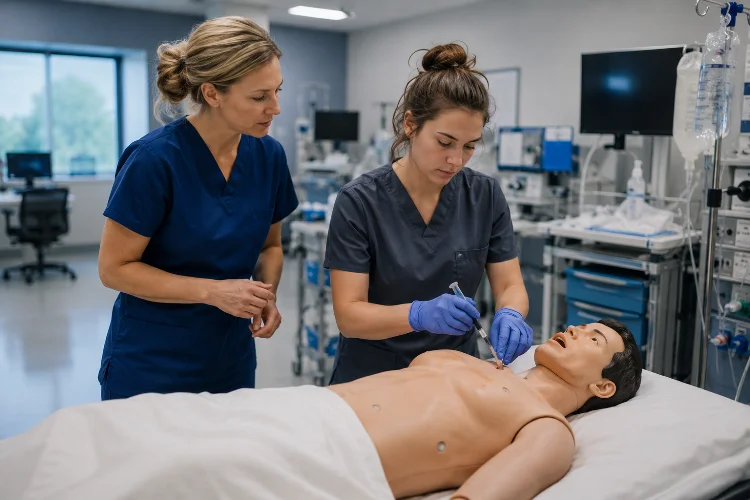
The first time a healthcare learner performs a clinical skill on a real patient can feel intimidating.
They may understand the theory perfectly, but remembering every step while communicating with the patient, monitoring safety, using equipment, and making decisions is a completely different challenge.
Simulation prepares learners for clinical practice by creating a controlled environment where those challenges can be practiced before the stakes become real.
Healthcare simulation can range from basic task trainers and standardized patients to high-fidelity mannequins, virtual simulations, and complex emergency scenarios.
The Agency for Healthcare Research and Quality notes that simulation-based training allows healthcare professionals to learn new skills, deliberately practice them, and receive focused feedback in a relatively low-risk environment.
Simulation is not meant to make clinical placements unnecessary. Instead, it helps learners arrive better prepared to use those real-world opportunities.
When simulation is designed well, students can practice technical skills, clinical reasoning, communication, teamwork, and even failure-without putting patients at unnecessary risk.
What Is Simulation-Based Clinical Learning?
Simulation-based learning recreates aspects of clinical practice so learners can experience realistic situations without relying entirely on real patient encounters.
The simulation may be simple.
A student might practice inserting an intravenous catheter using a task trainer. Another learner might conduct a health interview with a trained actor playing the role of a patient.
More advanced simulations can involve high-fidelity mannequins that respond to treatments, virtual environments, emergency scenarios, or multidisciplinary teams managing a deteriorating patient.
WHO educational guidance describes simulation as an interactive educational method that allows healthcare learners to practice within situations designed to resemble real clinical experiences.
Simulation in nursing and midwifery education has also been promoted as a way to improve quality of care while supporting patient safety.
The important part is not how expensive the technology is.
A successful simulation begins with clear learning objectives and gives learners an opportunity to think, act, receive feedback, and improve.
Simulation Lets Learners Practice Before Patient Safety Is at Risk
One of the greatest advantages of simulation is simple: learners can make mistakes without those mistakes directly harming a patient.
Imagine a student learning how to respond to anaphylaxis.
In a real emergency, there is little time to stop and explain why a particular action should happen first. The patient needs immediate treatment.
In simulation, the scenario can pause.
The educator can identify what the learner missed, restart the case, or let the student repeat the response until the sequence becomes clearer.
AHRQ describes simulation as a relatively risk-free environment that can bridge classroom instruction and real clinical experience while supporting deliberate practice and immediate feedback.
This does not mean errors should be treated casually.
Instead, simulation allows educators to turn mistakes into learning opportunities before similar problems appear in real clinical care.
The learner can ask a valuable question:
“What should I do differently next time?”
Repetition Builds Clinical Skills and Confidence
Watching a demonstration once rarely creates clinical competence.
Learners need practice.
Simulation makes repeated practice possible without waiting for the right patient to appear during a clinical placement.
For example, a student may need more practice performing an assessment, using emergency equipment, preparing medication, positioning a patient, or completing a particular procedure.
In a simulation environment, the skill can be repeated several times.
The educator can focus on one difficult component, provide feedback, and then have the learner try again.
The NCSBN National Simulation Study found substantial evidence that, under the conditions studied, high-quality simulation could replace up to 50% of traditional clinical hours in prelicensure nursing education without negatively affecting educational outcomes.
The finding does not mean all programs should automatically replace half of clinical experience, but it demonstrates how substantial well-designed simulation can be.
Repeated practice can also increase confidence.
The important distinction is that confidence should follow improving competence-not replace it.
Simulation Develops Clinical Reasoning
Clinical practice is not simply a sequence of procedures.
Healthcare professionals constantly have to decide what information matters, recognize changes, prioritize risks, and choose appropriate actions.
Simulation gives learners opportunities to practice this clinical reasoning process.
Imagine a simulated patient whose respiratory rate begins to rise.
The learner has to decide:
Is the change significant?
What should be assessed next?
What could be causing it?
Does the patient require immediate intervention?
When should someone more senior be called?
Rather than discussing these questions abstractly, simulation places the learner inside the decision.
Research reviewing simulation in clinical education has linked simulation-based approaches with improvements in areas such as clinical decision-making, critical thinking, knowledge, and practical competence, although outcomes can vary according to simulation design and context.
This is especially useful for situations learners may not encounter frequently enough during normal clinical placements.
Learners Can Practice Rare and High-Risk Situations
Clinical placements are unpredictable.
A student might spend weeks on placement without encountering cardiac arrest, severe allergic reaction, postpartum hemorrhage, difficult airway management, or another uncommon emergency.
That creates a problem.
Learners need preparation for high-risk situations, but educators cannot wait for a real emergency simply to provide experience.
Simulation can deliberately recreate these events.
A learner might practice identifying deterioration, calling for assistance, starting appropriate interventions, communicating with the team, and reassessing the patient’s response.
Scenarios can also be adjusted to suit different experience levels.
A beginner may focus on recognizing the emergency and knowing when to escalate. An advanced learner may need to coordinate several interventions while leading a team.
This ability to create repeatable clinical situations is one reason simulation has become widely used for individual skills, teamwork, emergency responses, and patient-safety education.
Simulation Strengthens Communication and Teamwork
Technical skill is only one part of safe clinical care.
Healthcare professionals must communicate clearly, divide responsibilities, share important information, and respond effectively when several people are working on the same problem.
Simulation provides a useful environment for practicing these non-technical skills.
Consider a simulated cardiac arrest involving nursing, medical, pharmacy, or other healthcare learners.
The scenario reveals much more than whether people know the correct treatment.
Who takes leadership?
Are instructions clear?
Does someone confirm that a task has been completed?
Are important changes communicated?
Does anyone speak up when they notice a potential error?
A systematic review and meta-analysis of randomized studies found that interprofessional simulation-based education can improve teamwork and communication among healthcare students.
These experiences also help learners understand professional roles.
Instead of simply reading that healthcare is collaborative, they experience what effective-and ineffective-collaboration actually feels like.
Standardized Patients Help Build Communication Skills
Not every simulation needs a sophisticated mannequin.
Sometimes the most useful simulator is another person.
Standardized patients are people trained to consistently portray specific clinical situations. They may present symptoms, answer questions, express emotions, or provide feedback about how the learner communicated.
For example, a learner could practice explaining a diagnosis to an anxious patient.
Another scenario might involve obtaining consent, discussing lifestyle changes, taking a sensitive history, or communicating with an upset family member.
These situations allow learners to practice the human side of healthcare before navigating similarly difficult conversations during real patient care.
A learner may discover that they use too much medical terminology, avoid discussing uncomfortable issues, interrupt too often, or forget to check whether the patient understands.
Simulation therefore provides opportunities to develop not just what clinicians do, but how they interact with people.
Debriefing Turns Simulation Into Learning
The scenario itself is only part of simulation-based education.
What happens afterward can be just as important.
Debriefing is the structured conversation following a simulation in which learners and facilitators examine what happened, why decisions were made, what worked well, and what could improve.
The educator might ask:
“What were you thinking when the patient’s condition changed?”
“What clues did you notice?”
“What did you miss?”
“What would you do differently next time?”
Debriefing helps learners connect their actions with the consequences of those actions.
A 2024 systematic review of healthcare simulation examined different debriefing approaches and reinforced the central role of structured reflection in simulation education.
The goal is not to embarrass learners for making mistakes.
A good debrief creates enough psychological safety for learners to discuss uncertainty and errors while still maintaining clear expectations for professional and clinical performance.
Good Simulation Needs Clear Design
Simulation is not automatically effective simply because a realistic mannequin or virtual-reality system is available.
Poorly designed scenarios can confuse learners or focus attention on irrelevant details.
Educators should start with a clear objective.
If the goal is recognizing patient deterioration, every part of the scenario should support that goal. There is little benefit in adding unnecessary complexity simply because the simulator can produce it.
Prebriefing also matters.
Before the simulation begins, learners should understand the environment, available equipment, expectations, confidentiality, and basic assumptions of the scenario.
The International Nursing Association for Clinical Simulation and Learning maintains Healthcare Simulation Standards of Best Practice designed to provide benchmarks for areas including simulation design, facilitation, professional integrity, and evaluation.
Strong simulation is therefore intentional education—not simply sophisticated technology.
Simulation Should Complement Real Clinical Experience
Simulation can reproduce many aspects of practice, but it cannot perfectly reproduce every part of caring for real people.
Actual patients have unpredictable needs, complex personalities, family dynamics, social circumstances, changing priorities, and emotional responses that are difficult to simulate completely.
Clinical placements also teach learners how real healthcare organizations function.
They experience workflow pressures, interruptions, interdisciplinary relationships, documentation requirements, and the responsibility that comes with caring for actual patients.
Simulation works best as a bridge.
It allows learners to practice before an encounter, strengthen weak areas afterward, and experience situations that may be too uncommon or dangerous to guarantee during placements.
Even the strong findings from the NCSBN simulation research depended on high-quality simulation conditions, including appropriately prepared faculty and structured educational experiences.
The goal should therefore be better preparation for clinical practice—not simulation for its own sake.
Understanding how simulation prepares learners for clinical practice starts with recognizing that healthcare competence requires more than memorized knowledge.
Learners need opportunities to perform skills, make decisions, communicate, work in teams, recognize deterioration, and learn from mistakes.
Simulation creates a controlled environment where those abilities can develop before learners face similar challenges with real patients.
Repetition strengthens skills, realistic scenarios develop clinical reasoning, teamwork exercises improve collaboration, and debriefing turns experience into reflection.
The strongest simulation programs do not attempt to replace the human complexity of clinical practice. They prepare learners to enter it more safely and confidently.
If you teach healthcare students, start by identifying one situation learners find difficult or rarely experience, then design a focused simulation that lets them practice, reflect, and try again.