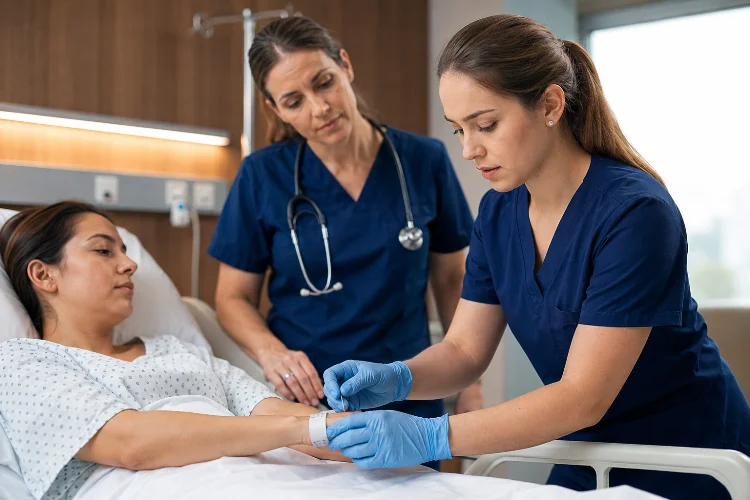
Clinical placements are designed to help learners become more independent, but independence cannot come at the expense of patient safety.
Students need opportunities to assess patients, make decisions, administer treatments, communicate with teams, and learn from mistakes-all while real people depend on the care being delivered.
This is where preceptors play a critical role.
Rather than treating safety as a separate lesson, effective preceptors build patient safety into clinical teaching throughout the working day.
They model good habits, explain why safety checks matter, supervise according to competence, encourage learners to speak up, and turn near misses into opportunities for improvement.
The World Health Organization’s Patient Safety Curriculum Guide was specifically developed to integrate patient safety concepts into education across healthcare professions, including medicine, nursing, pharmacy, dentistry, and midwifery.
For a preceptor, the practical message is simple: patient safety should not be something learners study only in a classroom. It should be visible in every clinical decision they make.
Make Safety Part of Everyday Clinical Thinking
Patient safety teaching becomes more meaningful when it is connected directly to real patient care.
Instead of occasionally saying, “Remember patient safety,” show learners what safe thinking looks like.
Before a procedure, ask:
“What could potentially go wrong here?”
“What checks should we complete first?”
“When would you stop and ask for help?”
These questions encourage learners to think about risk before acting.
WHO’s patient safety curriculum emphasizes integrating safety knowledge and skills into healthcare education rather than treating the subject as an isolated topic.
For example, when reviewing a patient whose condition has changed, do not focus only on identifying the diagnosis. Discuss what deterioration signs require immediate escalation, what information needs to be communicated, and what could happen if action is delayed.
Over time, learners begin to see safety as part of clinical reasoning rather than another checklist they need to memorize.
Match Supervision to the Learner’s Competence
Giving every learner the same amount of independence is neither efficient nor safe.
A first-placement student may need direct supervision for a task that an advanced learner can perform with much less assistance.
The preceptor therefore needs to continuously judge three things: the learner’s demonstrated competence, the risk associated with the activity, and the patient’s current condition.
NMC standards for student supervision and assessment require practice learning to include appropriate supervision while supporting students as they develop their knowledge, skills, confidence, and professional competence.
Consider a learner who has previously performed a wound dressing several times.
Instead of assuming they are competent, ask them to explain the procedure, relevant precautions, and what would cause them to stop. Then observe their performance before gradually reducing assistance.
Safe autonomy should be earned through demonstrated competence, not granted simply because a student has reached a particular week of placement.
Teach Learners to Pause Before High-Risk Actions
Experienced clinicians often develop routines that make safety checks look almost automatic.
Learners need those routines made visible.
Medication administration is a good example. Instead of allowing a learner to move immediately from prescription to administration, pause and ask them to explain what they have checked.
What medication is being given? Why does the patient need it? Is the dose appropriate? Are there allergies, interactions, contraindications, or monitoring requirements that matter?
Medication safety deserves particular attention because unsafe medication practices and medication errors remain an important source of preventable patient harm worldwide. WHO’s Medication Without Harm initiative specifically targets risks throughout the medication-use process.
The same “pause and check” habit can be applied to procedures, blood products, equipment, patient identification, clinical documentation, and other high-risk activities.
Preceptors are essentially teaching learners to develop a mental safety checkpoint before acting.
Model Infection Prevention Every Single Time
Few things undermine safety education faster than a preceptor saying one thing and doing another.
If you teach hand hygiene but skip it when the ward becomes busy, the learner receives a very different lesson from the one you intended.
CDC guidance describes Standard Precautions as basic infection prevention practices applied to all patient care, including hand hygiene and appropriate personal protective equipment based on anticipated exposure.
Preceptors should therefore make these practices visible.
When appropriate, briefly explain your reasoning:
“I’m performing hand hygiene again because I’ve just touched the patient’s surroundings.”
Or:
“We need eye protection for this procedure because there is a risk of splash exposure.”
This turns routine infection control into practical teaching.
Learners also need permission to correct unsafe behavior respectfully. If a student notices that you are about to miss an important safety step, their instinct should be to speak up—not remain silent because you are the senior clinician.
Teach Clear Communication and Escalation
Many safety problems are not caused by a complete lack of clinical knowledge. They arise because important information does not reach the right person clearly or quickly enough.
AHRQ identifies communication and teamwork as central parts of patient safety culture and notes that communication breakdowns can contribute to adverse events, particularly during transitions in care.
Preceptors can teach safer communication through everyday activities such as handovers, telephone calls, referrals, and escalation of deteriorating patients.
After a learner presents a concern, ask:
“Did the person receiving your message understand what you need them to do?”
This moves the focus beyond simply delivering information.
A learner might report:
“Mr. Jones isn’t looking very well.”
That communicates concern but provides little useful information.
The preceptor can help them organize the message around the patient’s identity, current problem, relevant observations, recent changes, and the specific action required.
AHRQ’s TeamSTEPPS program provides structured teamwork and communication tools intended to improve communication, situation awareness, mutual support, and patient outcomes.
Create a Culture Where Learners Can Speak Up
Students sometimes notice something wrong but hesitate to say anything.
They may fear looking inexperienced, challenging a senior clinician, or being judged for asking what seems like an obvious question.
That hesitation can become a safety problem.
Preceptors should explicitly tell learners:
“If something doesn’t look right, say something—even if you’re not completely sure.”
A strong safety culture depends on open communication, teamwork, respect, and the ability to raise concerns rather than remaining silent. AHRQ describes these characteristics as central to creating healthcare environments that prioritize safety.
How the preceptor responds is crucial.
If a learner says, “I think this might be the wrong dose,” avoid dismissing them with, “No, it’s fine.”
Instead, say:
“Good catch for checking. Let’s verify it together.”
Even if the original order is correct, the learner has practiced an important safety behavior: noticing uncertainty and speaking up.
Use Errors and Near Misses as Learning Opportunities
Clinical learners will make mistakes.
The goal is not to pretend errors never happen. It is to prevent avoidable harm and create a learning environment where mistakes, near misses, and unsafe conditions can be examined constructively.
A near miss is particularly useful for teaching because something could have caused harm but was detected before the patient was injured. AHRQ describes near-miss reporting as an opportunity to identify safety weaknesses and learn before actual harm occurs.
Imagine a learner almost administers medication to the wrong patient but notices the identification mismatch during the final check.
Do not end the conversation with:
“Well, nothing happened.”
Instead, explore the event.
“What stopped the error?”
“What factors made it possible?”
“Was there an interruption?”
“What should we do differently next time?”
This shifts attention from blame toward understanding the system and strengthening future safety behaviors.
Serious events, of course, must always be handled according to organizational reporting, disclosure, and escalation procedures.
Debrief Safety-Critical Situations
A short debrief after an urgent or unusual event can produce powerful learning.
Suppose a patient suddenly deteriorates and the clinical team responds rapidly. Once the patient is stable and immediate responsibilities are complete, take a few minutes with the learner.
Ask:
“What signs suggested the patient was deteriorating?”
“What did the team prioritize?”
“What communication worked well?”
“What would you do sooner if this happened again?”
AHRQ’s teamwork guidance identifies debriefing and feedback as useful components of teamwork and safety training, particularly after significant events.
The conversation does not need to last half an hour.
Even three focused minutes can help a learner turn an intense clinical experience into knowledge they can use in the future.
Model the Safety Culture You Want Learners to Develop
Ultimately, learners watch what preceptors actually do.
If a preceptor checks patient identity carefully, performs hand hygiene consistently, admits uncertainty, verifies unfamiliar medications, listens when colleagues raise concerns, and reports safety events appropriately, the learner sees what professional safety behavior looks like.
If the educator cuts corners whenever the shift becomes busy, that behavior is also being taught.
Patient safety culture is influenced by everyday behaviors, teamwork, leadership, communication, and how healthcare teams respond to mistakes and safety concerns.
This makes role modeling one of the most powerful tools available to clinical educators.
You do not have to announce every safety lesson. Sometimes, consistently doing the safe thing-and briefly explaining why-is enough.
Building patient safety into clinical teaching means making safety part of every patient encounter rather than saving it for a separate lecture.
Effective preceptors adjust supervision to learner competence, model infection prevention, encourage safety checks, teach clear communication, and create an environment where learners feel able to raise concerns.
They also recognize that near misses, mistakes, and unexpected clinical events can become valuable learning opportunities when handled constructively.
Most importantly, preceptors demonstrate through their own behavior that safe practice is not optional, even on the busiest shift.
During your next clinical session, choose one routine activity-medication administration, handover, assessment, or a procedure-and make the safety reasoning behind it visible. Small teaching moments can build habits that learners carry throughout their careers.