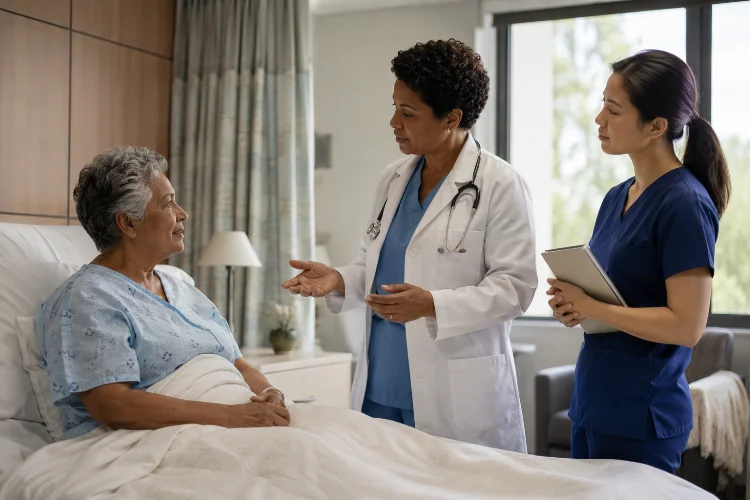
Bedside teaching is one of the few educational methods where students can connect textbook knowledge directly with a real person’s symptoms, concerns, physical findings, and healthcare experience.
Done well, it can teach clinical examination, communication, professionalism, decision-making, and empathy at the same time.
But effective bedside teaching requires more than bringing several learners into a patient’s room and discussing the case.
The patient is not simply a teaching resource. They are an active participant whose privacy, dignity, comfort, preferences, and consent must remain central to the encounter.
Guidance from the General Medical Council specifically states that explicit patient consent should be obtained when students observe care, and the student’s presence should not adversely affect that care.
For clinical educators and preceptors, the challenge is balancing two priorities: creating meaningful learning opportunities while maintaining respectful, patient-centered care.
With thoughtful preparation and a few simple habits, bedside teaching can achieve both.
Understand What Good Bedside Teaching Should Achieve
Bedside teaching means clinical education conducted in the presence of a patient. It allows learners to observe real clinical findings, practice communication, develop examination skills, and connect diagnostic reasoning with the patient’s actual experience.
Research reviews have found that bedside teaching can support development of clinical diagnostic skills and remains valued by patients, learners, and educators, even though its use has declined in some settings.
Its value extends beyond physical examination.
A learner can observe how an experienced clinician introduces themselves, asks sensitive questions, explains uncertainty, responds to patient concerns, and adapts communication when someone is anxious or uncomfortable.
These professional behaviors can be difficult to teach through slides or textbooks.
The goal, therefore, should not be to fit as much medical information as possible into one encounter. It should be to select a meaningful learning objective and teach it without compromising the patient’s experience.
Prepare Learners Before Entering the Room
A few minutes of preparation can make bedside teaching far more organized.
Before approaching the patient, tell learners what you want them to focus on. Perhaps the objective is recognizing signs of fluid overload, practicing a neurological examination, taking a focused history, or observing patient-centered communication.
This prevents learners from entering the room without knowing what matters.
You can also discuss sensitive information outside the bedside when appropriate.
For example, if there are complex social circumstances, uncertain diagnoses, or topics that might cause unnecessary anxiety, decide beforehand how those issues will be handled.
Keep the preparation brief. Bedside teaching works best when the educational goal is focused rather than trying to cover the patient’s entire medical history.
A useful pre-brief might be:
“Today, focus on how the patient’s symptoms relate to the cardiovascular examination. Afterward, I’ll ask you which findings changed your clinical impression.”
Now everyone enters with a purpose.
Always Ask the Patient for Permission
Patient consent is fundamental.
Do not assume that because someone is receiving care in a teaching hospital, they automatically agree to participate in every educational encounter.
The GMC advises clinicians to obtain explicit consent for student observation of care and to ensure that student involvement does not negatively affect the patient’s treatment or ability to communicate openly.
Explain what will happen in language the patient can understand.
For example:
“I’m working with two healthcare students today. Would you be comfortable with them joining us while we discuss your symptoms and examination?”
If students will perform an examination, explain that separately.
Patients should also understand that declining is acceptable and should not affect the care they receive.
Research examining patients’ perspectives suggests that many patients view bedside teaching positively, but willingness to participate can depend on factors such as comfort, respect, health status, and the nature of student involvement.
Consent should therefore be treated as an ongoing conversation rather than a formality.
Introduce Everyone and Include the Patient
Once inside the room, avoid creating a circle of healthcare professionals who discuss the patient as though they are not there.
Introduce everyone.
Explain briefly why the group is present and what you hope to do.
Then involve the patient in the conversation.
Instead of telling learners, “This is a 67-year-old male with worsening heart failure,” you might begin with the patient:
“Would you mind telling us what brought you into hospital this week?”
The patient becomes a participant rather than an exhibit.
Patient-centered bedside teaching can also reveal details that disappear when cases are presented only from medical records. Patients may explain how symptoms affect everyday life, which concerns matter most to them, or what they understand about their treatment.
Professional ethical standards recognize patients’ rights to dignity, respect, appropriate information, and meaningful involvement in their healthcare.
Modeling those behaviors teaches professionalism while teaching medicine.
Protect Privacy and Dignity During Examination
Physical examination creates additional responsibilities.
Expose only the area necessary for the examination and maintain appropriate draping. Consider whether doors or curtains need to be closed and whether the number of learners present is reasonable.
Explain what you are going to do before touching the patient.
If a learner performs the examination, make sure their level of skill and supervision is appropriate. GMC guidance on clinical placements emphasizes adequate supervision when students participate in clinical activities so that patients remain safe.
Pay attention to nonverbal communication too.
A patient may have agreed initially but later appear uncomfortable, tired, or distressed.
That is a reason to pause.
An excellent teaching point can always be discussed elsewhere. Patient dignity should not be sacrificed simply because the educator wants to finish the lesson.
Ask Questions Without Embarrassing the Learner or Patient
Bedside questioning is useful, but location matters.
Imagine asking a student in front of the patient:
“What is the worst possible diagnosis here?”
The question may be educationally reasonable, but hearing learners discuss frightening possibilities could cause unnecessary anxiety.
Some diagnostic reasoning is better discussed outside the room.
At the bedside, focus questions on observations and information that can be discussed respectfully.
You might ask:
“What do you notice about the patient’s breathing?”
“Could you explain what you are checking during this examination?”
“What additional question would you like to ask?”
These prompts involve the learner without turning the encounter into an interrogation.
Avoid humiliating students for incorrect answers. A learner who is afraid of being embarrassed may focus more on avoiding mistakes than on listening to the patient.
Bedside teaching works best when both learner and patient experience the environment as respectful and psychologically safe.
Demonstrate Communication as Well as Clinical Skills
Preceptors often think they are demonstrating an examination technique when they are actually teaching much more.
Learners notice how you knock before entering, introduce yourself, position yourself near the patient, explain procedures, respond to emotion, and close the conversation.
Make these behaviors intentional.
Suppose the patient says:
“I’m worried this means my condition is getting worse.”
Do not immediately return to teaching the students.
Respond to the patient.
Acknowledge the concern and address it appropriately before continuing.
This models an essential principle: the clinical agenda does not automatically outrank the patient’s agenda.
Studies of patients involved in medical education show that patients can value contributing to student learning, particularly when interaction remains respectful and they feel properly included.
Good bedside educators therefore teach clinical competence and bedside manner simultaneously.
Keep the Teaching Focused and Time-Conscious
Long bedside discussions can exhaust patients.
You do not need to teach everything while standing beside the bed.
Select what genuinely benefits from the patient’s presence: history-taking, communication, examination findings, clinical observation, or patient education.
Save lengthy discussions about differential diagnoses, pathophysiology, laboratory interpretation, or management controversies for afterward.
This creates a useful three-stage structure:
Before the bedside
Prepare learners and identify the educational objective.
At the bedside
Engage the patient, observe or demonstrate relevant clinical skills, and ask focused questions.
After the bedside
Discuss clinical reasoning, uncertainties, alternative diagnoses, and broader teaching points.
Research on bedside teaching has repeatedly identified time constraints as a practical barrier, which makes structured and selective teaching especially important.
A focused ten-minute bedside encounter can often teach more effectively than an unfocused thirty-minute round.
Debrief With Learners After Leaving the Bedside
Do not let the lesson end when you leave the patient’s room.
Find an appropriate private area and ask learners what they noticed.
“What findings were most important?”
“Did anything change your initial impression?”
“What did you notice about the patient’s concerns?”
“What would you do next?”
Now you can explore diagnostic possibilities without worrying about confusing or alarming the patient.
This is also the ideal time for feedback.
If a learner performed an examination, identify something specific they did well and one area to improve.
For example:
“You explained each part of the abdominal examination clearly, which helped the patient know what to expect. Next time, slow down during palpation and watch the patient’s face for signs of discomfort.”
Specific feedback turns a bedside encounter into an experience the learner can improve upon next time.
Finish the Encounter With the Patient, Not Just the Learners
Before leaving, return attention fully to the patient.
Thank them for participating.
Ask whether they have questions or whether anything discussed needs clarification. If students have used unfamiliar medical terminology, make sure the patient has not been left confused about their condition.
This final step is easy to overlook.
Educators may become excited about an interesting clinical finding and leave the room discussing it with learners. From the patient’s perspective, however, that can feel like being examined and then abandoned.
Ending respectfully reinforces that the patient was a partner in the teaching encounter.
That simple behavior may be one of the most important lessons students observe all day.
Respectful and effective bedside teaching combines clinical education with patient-centered care. It begins with a clear objective and learner preparation, but patient consent, dignity, privacy, comfort, and safety must remain central throughout the encounter.
Educators should involve patients in conversations, keep teaching focused, supervise learners appropriately, avoid embarrassing questions, model excellent communication, and move sensitive clinical reasoning discussions away from the bedside when necessary.
The most memorable bedside teachers do more than demonstrate clinical knowledge. They demonstrate how knowledgeable clinicians treat people.
Before your next bedside session, choose one focused learning objective and ask yourself one additional question: “How can I make this educationally useful for the learner while still making the patient feel respected and included?”