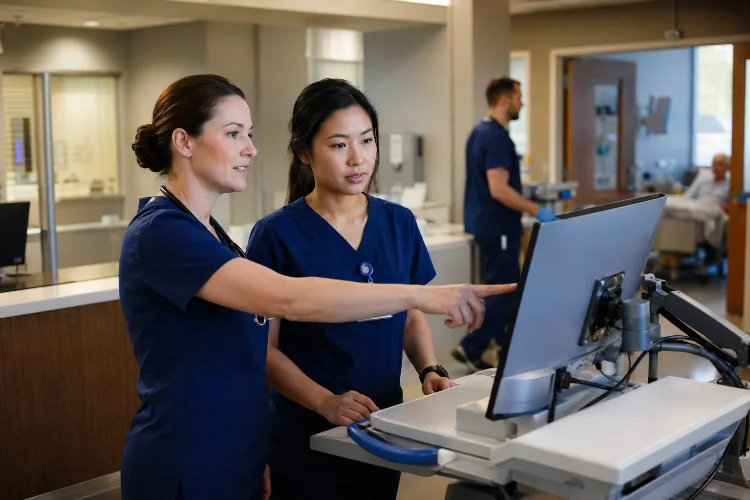
A busy clinical shift rarely feels like the perfect environment for teaching. Patients need attention, documentation keeps growing, new problems appear without warning, and the healthcare team is constantly adjusting priorities.
Add a student or trainee to the mix, and teaching can easily feel like one more task on an already crowded schedule.
Yet teaching effectively during a busy clinical shift does not require long lectures or dedicated classroom sessions. Some of the most useful clinical teaching happens in short conversations built around real patient care.
Research on workplace-based education has long recognized time pressure and competing clinical demands as major challenges for clinical educators. At the same time, practical teaching models can help educators use brief encounters more efficiently.
The key is to teach intentionally. Instead of trying to explain everything, focus on one useful lesson at a time, involve the learner in clinical reasoning, and use feedback to connect one patient encounter to the next.
Set One or Two Learning Goals at the Start of the Shift
Trying to teach everything during one shift usually leads to teaching very little effectively.
Spend a minute at the beginning of the day identifying one or two realistic learning priorities.
Ask the learner:
“What would you like to get better at today?”
Then connect their answer with the clinical opportunities likely to appear during the shift.
For example, a student might want to improve patient handovers. Instead of waiting for a formal teaching session, agree that they will present two patients during the shift and receive brief feedback afterward.
Clinical teaching guidance recommends establishing clear expectations and learning goals because focused objectives help teachers and learners use limited clinical time more efficiently.
A small goal also makes progress easier to notice.
“Learn cardiology” is impossible to accomplish during one shift. “Present one patient with chest pain and explain the three most likely causes” is achievable.
Turn Routine Patient Care Into Micro-Teaching
Busy shifts already contain teaching material.
The educator does not always need to create additional activities. Instead, look for micro-teaching opportunities inside the work that is already happening.
A medication review can become a two-minute pharmacology lesson. An abnormal blood pressure can lead to a discussion about deterioration. A discharge conversation can teach patient education. A handover can demonstrate structured communication.
For example, while reviewing a laboratory result, you might ask:
“This patient’s potassium has dropped. What are the possible reasons?”
After the learner answers, add one useful teaching point and move on.
Evidence-based clinical teaching guidance recommends keeping some workplace teaching encounters brief and focused so learning can occur without unnecessarily interrupting clinical workflow.
The goal is not to turn every patient into a twenty-minute tutorial.
One good question plus one useful teaching point can be enough.
Use the One-Minute Preceptor for Fast Clinical Teaching
One of the best-known tools for teaching under time pressure is the One-Minute Preceptor, sometimes called the Five-Step Microskills Model.
The approach encourages educators to ask learners to commit to an interpretation or plan, explore their reasoning, teach a general principle, reinforce what they did well, and correct mistakes.
Research has shown that the model can improve specific teaching behaviors and provide a practical structure for short clinical interactions.
Imagine a learner evaluating a patient with worsening shortness of breath.
Instead of immediately giving your opinion, ask:
“What do you think is happening?”
Then follow with:
“What findings support that?”
Once you understand their reasoning, add a brief teaching point.
For example:
“When respiratory symptoms worsen rapidly, think about both the likely diagnosis and the dangerous alternatives you cannot afford to miss.”
Finish with specific feedback.
“Your assessment identified the major respiratory findings. Next time, include the patient’s recent fluid balance earlier in your presentation.”
The entire conversation may take only a few minutes.
Ask Questions Instead of Giving Mini-Lectures
When time is limited, questions often teach more efficiently than explanations.
If an educator talks for ten minutes, the learner may remember only part of the information. A focused question forces the learner to retrieve knowledge, organize it, and apply it to the patient in front of them.
Start with questions such as:
“What concerns you most?”
“What do you think is causing this?”
“What would you do next?”
“What would make you escalate?”
These questions reveal how the learner is thinking.
If the answer is incomplete, provide a prompt rather than immediately taking over.
For example:
“Look again at the patient’s medications. Does anything there change your thinking?”
This keeps the learner mentally involved while allowing teaching to continue quickly.
Clinical teaching reviews emphasize learner participation, questioning, feedback, and active clinical reasoning rather than relying solely on passive observation or lengthy instruction.
Match Teaching to the Learner’s Level
Efficiency improves when educators avoid teaching either far above or far below a learner’s ability.
A beginner might need help identifying basic abnormal findings.
An advanced learner may already recognize them and instead need questions about prioritization, differential diagnosis, or management.
Before giving a long explanation, ask what the learner already knows.
For example:
“Have you managed this type of patient before?”
or:
“Talk me through what you would normally do.”
Their answer quickly shows where teaching should begin.
This also prevents educators from repeating information the learner already understands.
Recent perspectives on effective medical teaching continue to highlight the importance of adjusting instruction to individual learners while creating an environment where they can safely admit uncertainty or make mistakes.
Efficient teaching is not simply faster teaching. It is teaching the right thing at the right level.
Prioritize Patient Safety Over the Teaching Opportunity
No educational goal is more important than safe patient care.
During busy or unstable clinical situations, teaching may need to become shorter, delayed, or temporarily stopped.
Learners should also receive supervision appropriate to their competence and the risks involved in the activity. Professional standards for practice learning emphasize that supervisors should support student learning while maintaining public protection and appropriate oversight.
Suppose a patient’s condition is rapidly deteriorating.
That is probably not the moment for a detailed discussion about pathophysiology.
Instead, involve the learner in safe tasks appropriate to their level. Once the patient is stable, return to the event:
“What signs told us the patient was deteriorating?”
“What did we prioritize first?”
“Why?”
This approach protects the patient without losing the learning opportunity.
Sometimes the best teaching happens after the urgent work is finished.
Give Feedback in Small, Useful Pieces
Feedback does not have to be a formal fifteen-minute meeting.
During a busy shift, brief and specific feedback can be more practical.
Instead of:
“Good job with that patient.”
Try:
“You identified the main problem quickly and escalated appropriately. Next time, give the latest vital signs earlier when you call for help.”
That takes seconds but gives the learner something concrete to repeat and something specific to improve.
Research on clinical feedback emphasizes that useful feedback should be connected to observed performance and provide information learners can act on.
Avoid saving every correction until the end of the placement.
Small feedback conversations throughout the shift help learners adjust their performance immediately.
At the same time, do not correct every tiny detail. Choose the issue that matters most for patient safety, clinical reasoning, communication, or the learner’s current goal.
Let Learners Help With Real Work
Teaching becomes much harder when the educator performs all the clinical work while the student simply watches.
Whenever safe and appropriate, give learners meaningful responsibility.
A learner might take a focused history, perform part of an examination, prepare a patient presentation, review medications, explain discharge instructions, or summarize investigation results.
The educator can then review the work rather than repeating it from the beginning.
This creates learning while contributing to the workflow.
Of course, responsibility should match competence and supervision requirements. The idea is not to use students as extra staff but to make legitimate clinical activities part of their education.
Workplace learning is strongest when learners participate meaningfully in real professional practice rather than remaining passive observers. Clinical teaching literature also emphasizes active participation as an important component of effective workplace education.
Use Short Pauses for Reflection
Reflection does not require a journal entry after every patient.
Sometimes thirty seconds is enough.
After an interesting encounter, ask:
“What did you learn from that?”
“What surprised you?”
“What would you do differently next time?”
These questions help turn activity into learning.
Without reflection, learners can move through a busy shift completing task after task without stopping to understand what changed in their thinking.
You can also use quieter moments strategically.
Walking between clinical areas, waiting for an investigation, or completing a transition between patients can create opportunities for short discussions that do not interfere with care.
A busy shift may contain fewer long teaching sessions, but it often contains dozens of small moments that can be used intentionally.
End the Shift With a Two-Minute Debrief
Before everyone leaves, return to the learning goal you set at the beginning.
Ask:
“What is one thing you learned today?”
“What should we focus on next time?”
Then add your own observation.
For example:
“Your patient presentations became much more focused today. Next shift, let’s work on explaining your differential diagnosis.”
This creates continuity between shifts.
It also helps learners see that clinical education is a progression rather than a collection of unrelated patient encounters.
Faculty development research has identified both time pressure and limited formal preparation as challenges for clinicians who teach in busy environments. Structured strategies and deliberate teaching habits can make clinical instruction easier to incorporate into everyday work.
You do not need to finish the day having taught everything.
You simply need to leave the learner a little more capable than when the shift started.
Learning how to teach effectively during a busy clinical shift is largely about using limited time intelligently.
Start with one or two focused goals, turn routine patient encounters into micro-teaching opportunities, ask short clinical reasoning questions, and use structured tools such as the One-Minute Preceptor.
Keep patient safety at the center, match responsibility to learner competence, and provide feedback in small, actionable pieces. Even a two-minute discussion can become valuable teaching when it is intentional.
Clinical educators do not need to choose between caring for patients and teaching learners every time the workload increases. Instead, look for teaching opportunities inside the work already happening.
On your next shift, choose one learner goal and identify three brief moments where ordinary clinical care can become a lesson.